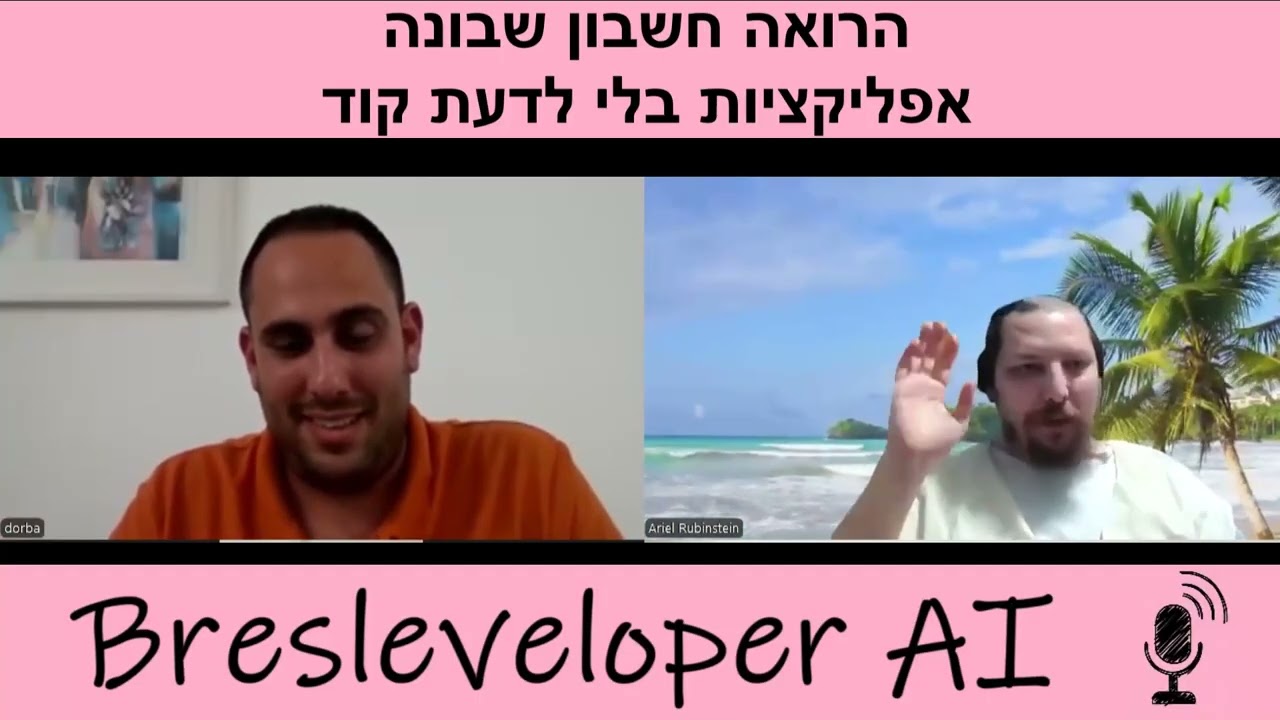
Episode 10 of the podcast hands the mic to a guest from the community: Matan, a CPA with six years in the finance departments of large companies and exactly zero years as a programmer. He has built dozens of apps with AI, and one of them is now live on Google Play. Ariel admits up front that he has never pulled that off himself: twice in the past he gave up at the store-upload stage and paid someone about 2,000 shekels to do it for him. So this hour is part inspiration, part technical war story, and part lesson in keeping things stupidly simple.
A year and a half, not a weekend
Matan is careful to frame the timeline. The Google Play app didn’t take a year and a half. The learning did. About eighteen months ago a friend told him someone had built an app on Base44 just by describing it in plain words, and as a lifelong “ideas guy” with notebooks full of problems and solutions since elementary school, he couldn’t resist.
His first real project came from his own street: neighbors helping neighbors. A neighbor abroad had a power outage at home with the kids inside, right before Shabbat, and the cry for an electrician drowned in the noise of the building’s WhatsApp group. Matan’s app let a neighbor post a need, and anyone within about 500 meters could see it and help.
He shelved it, on purpose. Once an app holds people’s addresses, medical issues and other sensitive details, the responsibility jumps. He wasn’t confident yet about the security side, so the project went on a low flame while he kept learning. Ariel’s takeaway for the audience: stop chasing the finish line by yesterday. Sometimes the finish line is two years out, and that’s fine.
What Base44 actually is
For anyone who hasn’t seen it, Ariel did a quick live demo. Base44 (one of six or seven similar tools) lets you type “build me a CRM” and get a working web app with a dashboard, customers and projects. These apps live on the web: you share a link and people use them.
Ariel’s history with it is honest. When Base44 launched, he considered it one of the worst tools out there. Lovable was the average choice and Replit was for complex projects, so for a long time his advice was “use Base44 to get a feel, then go to Lovable.” After hearing Matan’s story, he publicly takes his hat off: the company had a good idea, shipped a weak product, and instead of quitting it kept improving until it became genuinely strong. His new recommendation, especially for anyone who wants a real mobile app: go back and look at Base44’s app agent.
The missile game that went global
During the war, sitting in shelters, Matan thought of a game he could make: shoot down incoming missiles. A simple, cartoony 2D game built entirely in Base44 by describing it. For the look he used a trick worth stealing: he asked Gemini to write him a high-level design prompt for Base44, then fed that prompt back into Base44.
Then came the marketing, with zero ad budget. He posted in AI and gaming groups around the world, hunted specific niches on social platforms, and the game spread to dozens of countries (around 80 by his count later in the conversation) with thousands of players.
Next he entered Vibe Jam, a month-long global game competition with 955 entries built on everything from Unity to platforms Ariel had never heard of. As far as Matan knows, he was the only one using Base44. Until about day 27 he was leading the most-played chart, he finished among the most-played games, and the judges ranked him 110th out of 955. Not bad for a 2D “pew pew pew” game made by an accountant.
Ariel’s lesson: the world wants simple things. Clever, sophisticated products often lose money; the formula is to take a problem that really hurts people and give it a simple solution. He compared it to Elon Musk, whose first coded creation was a small game sold for $500. Start with what your tools can do now, and do it properly.
Getting into Google Play: the real boss fight
Base44 can package your web app into a file you upload to Google Play. Before that, it runs an AI review of your app, estimates how likely Google or Apple is to accept it, and generates a fix prompt you can apply. Matan’s warning: that fix prompt can just as easily break your app, so you need to know how to work with it. Base44 also published a step-by-step guide to opening a developer account (a one-time fee of about $25).
Then the wall. New personal developer accounts on Google Play must run a closed test with at least 12 testers opted in continuously for 14 days before they can apply for production. Matan built a WhatsApp group of 20-plus friends and family, nagged them daily for two weeks, answered Google’s detailed questions about the feedback he got and what he improved… and around midnight a week later got a generic rejection: not enough testing.
The second round worked because of two things:
- A stranger who helped. Someone he met in a Facebook group offered to test and spotted a problem with the link Matan was sharing. Whatever the exact mismatch was, fixing it mattered.
- Personal, daily contact. Instead of a group that people mute, he used a WhatsApp broadcast list plus personal voice messages to each person, every day: “I know you already gave me two weeks. This is my dream, to build an app without knowing how to code. Help me make it happen.”
One night around 11 PM the approval arrived. He rebuilt and re-uploaded the file from Base44 for safety, and the next day the app was live on Android. Ariel notes that store submissions have exploded since the AI era began, so the stores are deliberately making it harder. Getting approved is a success story on its own.
He also hit a few more walls: Google Play’s data-safety questionnaires (where he consulted real experts, not just the chatbot), and Google’s ad network rejected his game three times. He’s still working on that.
Shani’s question: website or app?
Shani, Ariel’s star student, built her own app with Cursor and Claude Code over about three months: photograph pages of a book and it extracts the text, translates it, reads it aloud, and builds summaries and a notebook. She’s dyslexic, reads around 20 books a year anyway, and built it first for herself. Should she put it on Google Play?
Ariel’s technical answer is a good rule of thumb. Move from a website to a native app only when:
- The user is in the field and has to work from a phone, not a laptop, or
- You need instant notifications, the “ding” you only get reliably on a phone.
Otherwise, a mobile-friendly website does the job and users can just open it. And there’s a middle path: Telegram and Discord bots are very powerful app shells for an agent. WhatsApp bots work for simple things but are complicated for many reasons. Paid APIs (she uses cloud OCR and a speech service) cost the same either way.
His personal advice: take it to people who share the struggle, get feedback, work with them until it’s simply good, and prove real demand before fighting the app store. Matan agreed: if it already works well as a website, go talk to people, go to conferences, and plan backwards from the goal.
Entrepreneurial spirit and the shoe size rule
Ariel keeps returning to one point: if you don’t want to talk to people, you might be a technologist with product ideas, but you’re not an entrepreneur. He’s candid about himself. He has coded since age eight, led teams, and built about 80% of a major national statistics website before leaving after a management change. He knows he’s a technologist at heart, which is exactly why he invests so heavily in YouTube. “Know your shoe size,” as he puts it, and if you’re not there yet, practice.
If he could talk to himself on his first day as a freelancer, he’d say: build Tetris. Ten Tetris apps, each with its own twist. And he tossed the community a challenge: a “master Tetris” app where anyone can add a prompt to create their own variant.
Lessons from the field
- MVP, then stop. Matan learned it on the neighbors app: AI makes adding features addictive, and every feature makes the app heavier and more fragile. Ship the lean core, check people actually need it, add later.
- AI explains itself. Ariel’s favorite line: a kettle can’t explain how to use a kettle, but AI is the first technology ever that can explain how to use itself. Ask, screenshot, ask again.
- Programmers’ only edge is vocabulary. The panel debated it. Ariel’s view: a programmer knows a bit more technical language and can jump to a specific line of code. Non-programmers can close most of the gap by splitting their software into three to five separate areas and managing each independently.
- Agents for everyday life. Examples from the chat: an agent that tailors and sends 30-40 CVs a day for a job seeker, and one that pings when a vacation price drops.
- Most people are good. Ariel says every CEO he ever knocked on the door of agreed to tell him how they started. Ask for help with humility and good questions, just don’t be a leech.
Matan’s latest: a 16-level alphabet-learning app for his six-year-old son, shared in teacher and parent groups, now with a voice API. Same recipe: find a painful problem, find the people who have it, go to them.
🔥 Roast Corner
Let’s start with the scoreboard. Ariel: coding since age eight, built most of a national statistics website, thirty years of experience, and twice paid a guy 2,000 shekels to press “upload” on Google Play. Matan: an accountant. An actual accountant. Did it himself, from a phone game he made in a bomb shelter. Ariel, you didn’t lose to a senior engineer. You lost to a man whose natural habitat is Excel.
And then, after three decades of architecture and SharePoint and agent loops, the great wisdom Ariel would send back in time to his younger self is… “build Tetris.” Ten of them. That’s the whole revelation. Somewhere a Soviet programmer from 1984 is nodding slowly.
But the real villain is Google. Twelve testers, opted in, for fourteen consecutive days, then a generic rejection at midnight. Then, as a bonus, Google’s ad network rejects the same game three times. So Google is very happy to have Matan recruit its unpaid QA team, it just doesn’t want to pay him a cent. It’s the only company on Earth that can make an accountant feel underbilled.
🤖 AI for Humans
Shani built a reading app partly because dyslexia once got her written off. Here’s a team doing something similar for kids. Four students at Instituto Superior Técnico in Lisbon founded Dyscovery, an AI reading companion for children with dyslexia. A child practices reading in a guided exercise that works like “reading karaoke,” and the app then gives feedback on how they did, with corrections and tips for both reading and writing. It’s built to support teachers and families, not replace them.
Dyslexia is estimated to affect around 120,000 children in Portugal alone, according to the Portuguese Dyslexia Association. Dyscovery is now in its second pilot phase in five schools across the Lisbon, Coimbra and Leiria regions, with over 100 students taking part, and it has already won the People’s Choice Award at the MIT €100K Portugal competition and the Portuguese national round of the Hult Prize.
That’s the same pattern this episode keeps preaching: a painful, real problem, a simple daily habit, and people who actually have the problem in the room while it’s being built.
💬 Comments