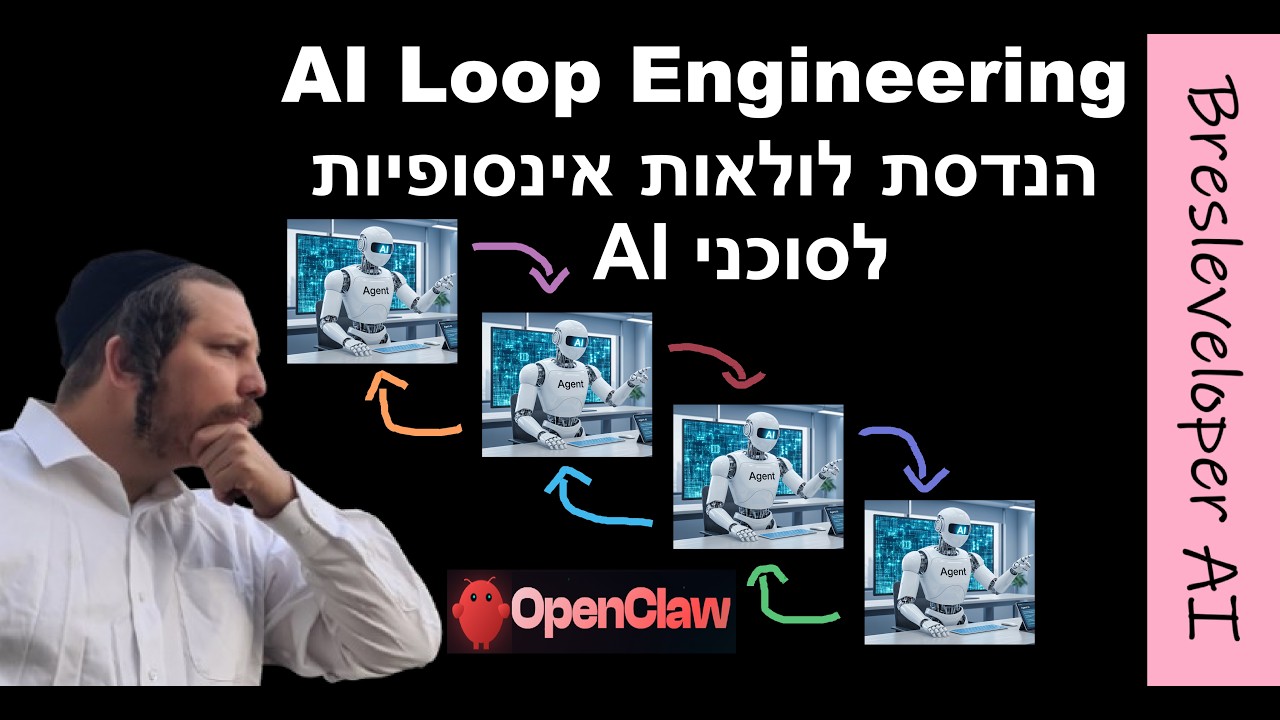
There is a difference between talking to an AI and handing a task to an agent.
When you chat with Claude or Cursor and your prompt is unclear, the model pauses and asks. “What did you mean here?” That is polite, but it is also a wall. The conversation stops until a human shows up with more words.
Autonomous agents do not stop. You give them a job, and they run. Bad context? They still run. Confusing instructions? They still run. The whole point is that the agent does not wait for you to finish the thought. It acts, checks the result, and acts again. This video is about the architecture that makes that loop possible — and the discipline it takes to keep it from spinning out of control.
From prompts to loops
Ariel starts with prompt engineering: write enough words so the chatbot knows what you want. Subject, current state, desired state, operating instructions, general rules, self-test procedure. Once that works once, the next move is to make it run twenty times, then two hundred times, without a human typing each trigger.
That shift changes everything. You are no longer prompting a chat. You are building a machine that keeps working while you sleep.
Tools like Claude Code and Cursor are interactive. They are designed to ask when the input is weak. OpenClaw-style autonomous agents go the other way: they execute with whatever you gave them. The current generation of OpenClaw, Ariel notes, has been trained a little too cautiously — too much “lean back and ask.” His fork pushes the agent back toward execution: less hand-holding, more doing. The risk is real, but that is the whole point of an autonomous agent.
The heartbeat that keeps the agent alive
Autonomous agents need a trigger. Two common ones:
- Cron — a scheduled reminder. Every five minutes, every day at 05:00, every Sunday.
- Heartbeat — a richer scheduler with more capabilities, better at handling complex, multi-step missions.
Either way, the agent wakes up, reads its mission, takes action, and goes back to wait. Without this pulse, it is just a script you forgot to run.
Loop engineering: no exit condition
The real subject of the video is loop engineering. A loop, in this sense, is not a for loop that counts to ten. It is a goal with no fixed end:
Keep improving the product every day. Keep making the support agents faster. Keep posting cat hearts until the channel owns the internet.
Ariel draws the loop as nested layers:
- Outer loop — the infinite one. Run forever, or until the company goes bankrupt. Wake up, set goals, allocate work, gather data, review, repeat.
- Goal loop — a specific improvement target. Example: reduce average support response time from 30 seconds to 25 seconds. Try a change, measure, if it failed try again.
- Execution loop — the inner machinery. Spin up sub-agents or coding sessions (Claude Code, Codex, Cursor SDK, etc.), make the change, test it, report back.
The outer manager decides whether the work is good enough. If yes, it returns to the outer loop and picks the next goal. If not, it sends the same task through again. The agent never says “I am done.” It says “I finished this round.”
Three examples from the video
1. Daily product improvements
Give the agent access to your site and a simple instruction: every day, look at what is trending, think of a new feature, and build it. The agent checks out the context, plans the change, writes code, runs tests, and deploys. Version control and rollbacks are non-negotiable here — the agent will break things, and you need a fast way back.
2. The endless cat-hearts channel
A sillier but clearer example: build a YouTube channel about cat hearts. Every day the agent searches the web for fresh cat-heart content, generates images and videos, and posts them across ten social networks. The goal loop breaks the work into sub-tasks: find five new items, make five images and five videos, publish to each platform. The outer loop never closes; it just waits for tomorrow and starts again.
3. Support team optimization
A support center has three AI agents answering users. A team-lead agent reviews all transcripts once a day, measures satisfaction, and notices a recurring complaint: the agents are too slow. It sets a goal — get average response time under 25 seconds — and spins up an engineering agent to modify the three support agents. The change is tested, measured, reviewed, and either accepted or sent back for another round.
Why this is hard
The video keeps returning to one idea: the agent does not ask. If you give it bad instructions, it executes bad instructions. If you forget to tell it to test, it will ship broken code. If you do not give it a rollback path, it will overwrite something important while you are eating lunch.
Loop engineering is therefore not about removing humans. It is about moving humans to the right place: defining the mission, the guardrails, the measurements, and the kill switches. The agent handles the repetitions.
🔥 Roast Corner
Most “AI agent” demos are a cron job wrapped in a landing page.
The hard part was never making a model do something on a schedule. The hard part is making the thing it does safe enough to run unsupervised, measurable enough to know if it helped, and reversible enough that you can sleep through the night.
A lot of agent frameworks skip all three. They ship “autonomy” as a feature and quietly leave out observability, rollback, and evaluation. Then they act surprised when the agent rewrites the production database because the prompt said “improve the app” and the model decided the schema was the problem.
Loop engineering, done right, is boring infrastructure wearing a cheap wizard hat. The real product is discipline: clear goals, clear tests, clear boundaries. Without those you do not have an agent. You have an expensive random number generator with commit access and a calendar invite.
🤖 AI for Humans
Imagine hiring an employee who never sleeps, never asks for clarification, and never stops working. That sounds amazing until you realize they also never pause to say “wait, this is a bad idea.”
That is the deal with autonomous agents.
The loop engineering idea is just a way of making that employee useful instead of dangerous:
- Give them a repeating mission — check the site, find a feature, build it.
- Give them smaller target loops — make the agents 5 seconds faster.
- Give them a way to check their own work — tests, measurements, a human review gate.
- Give them a way to undo mistakes — version control, backups, rollback plans.
When those pieces exist, the agent can keep working while you focus on bigger decisions. When those pieces are missing, the agent keeps working while you write the postmortem.
Published 2026-07-04 from the YouTube demo by Ariel Rubinstein.
💬 Comments