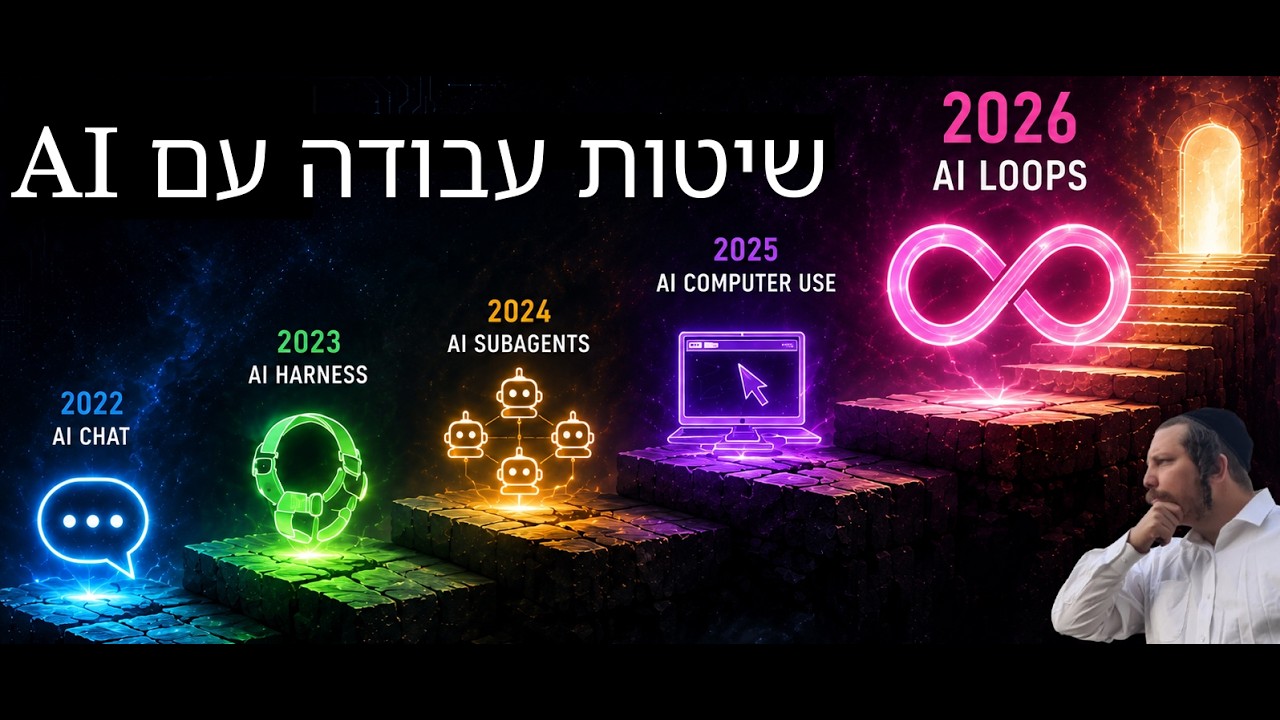
At the start there was a model. It did not matter if it was GPT or something else, big or small: you asked it something and it gave you an answer. That is how everyone used AI. Then people asked the obvious question, how do we make this better, and the answer turned out to be less about the model and more about everything we wrap around it. In this piece from episode 8 of Ariel’s podcast, he climbs that ladder rung by rung, gets cross-examined on his dates, and lands on his main claim for 2026: stop chasing the next model and start mixing the ones you have.
Rung one: chat, then the harness
The first step after “ask a model, get an answer” was the harness: the software around the model. Claude Code is the best-known one, and next to it Ariel lists Codex, Hermes, Antigravity and OpenClaw. The word itself comes from harnessing horses, and the formula Ariel uses is simple:
AI + harness = agent.
The model is the brain. The harness is the hands and legs: it reads files, runs commands, writes code and debugs it. Before the harness, you asked ChatGPT for code, copy-pasted it, ran it and pasted the errors back. With a harness you say “build me this” and it builds it, backend, frontend and database included.
His podcast partner keeps mixing up Hermes (a separate agent tool that competes with OpenClaw) and harness (the category all of them belong to), which leads to one of the more confusing and funnier exchanges of the episode. Ariel’s untangling is worth keeping: OpenClaw is a kind of harness, Hermes is another harness, and “harness” is the name of the family.
“Assistant” is not a technical word
Somewhere in between, the question comes up: wasn’t there an “assistant” stage before agents? Ariel’s answer: the word assistant changes its meaning every six months. First the assistant was ChatGPT. Then it was Merlin, a plug-in that sat on your email and answered for you. Then it was something on Windows that opened a chat wherever you clicked. Then OpenClaw broke the market and “AI assistant” came to mean something that can do everything. It is a marketing word. Harness, agent, sub-agent: those are technical terms, and they stay put.
Rung two: many agents
One agent struggles with a big task, so: let’s have several. This is multi-agent or sub-agents, and Ariel says it upgraded what we can do in a very significant way, even with the same old model underneath. The difference between the two terms, as he puts it:
- Multi-agent: you have several agents, and you talk to each of them.
- Sub-agents: your agent talks to them. You never talk to them directly.
Rung three: computer use
Next came computer use: the AI takes control of the computer itself, opens a browser, opens programs, sets things up. Ariel names Perplexity as the first relatively famous one, then OpenClaw, which broke the market, then Claude Desktop and the Codex desktop app. Codex desktop, he says, has a real advantage for Windows users: instead of talking Linux into a mini-Linux inside Windows and constantly tripping over it, it just talks to Windows in PowerShell.
There is a practical OpenClaw aside here, too. Until roughly the January to early February versions, OpenClaw just did everything. After that, many layers of permissions were added: it starts on a low profile, it is forbidden from a lot of things, and you have to grant them. If a friend’s OpenClaw “can’t open a browser”, the answer is in the settings, not in the model. Learn its configuration and open it up.
On dates, by the way, his partner calls him out (“you’re mixing up the years, bro”), and the timeline in the video is loose: ChatGPT in 2022, harnesses after it, multi-agent around 2024, computer use in 2025. Treat the years as the rough order of things, not as a history exam.
Rung four: multi-model, the 2026 jump
And now, in the middle of 2026, the new thing is multi-model. The popular pattern: implementation is done by Claude, and the code review is done by one of OpenAI’s models (Codex is OpenAI’s counterpart to Claude Code). You can add more: a security pass, another reviewer. Because each model’s weights are built differently, every extra model makes the result better.
Ariel’s main claim follows from that: right now, the main quality improvement in AI for 2026 comes from multi-model, more than from improving the models themselves. The same way the jump with computer use came from letting AI use real tools, mixing models is what lifts us now. “We don’t need to chase the next model. We need to chase how we use concepts like agentic looping.” With the best harness, computer use and a mix of models, he says, you can take mediocre models and get better results than a single top model on its own.
That only works with good planning. Ariel congratulates his partner on a 45-page spec and says the biggest spec he has handled was 600 or 800 pages. A random WhatsApp bot does not need that, but the principle stays: define the needs, define what success looks like, define the extra checks (security review by another model, code review by another model), and then let it run. That last part is agentic looping: a top-level task, a check every X minutes whether the previous step is done, and on to the next one, non-stop, until the result is there. (If you want the full version of that, we wrote it up in Agentic Looping That Actually Runs, from the same podcast.)
The clip: better than Fable?
A short clip from the same conversation shows the proof Ariel had on screen.
First, Microsoft. Its security team built a harness called MDASH and pointed several models at the problem of finding vulnerabilities together, each one trying its own direction and helping the others. On a cyber-defense leaderboard where Anthropic’s Mythos sat on top, the combined system came out ahead. The facts behind it, from Microsoft’s own announcement: MDASH orchestrates more than 100 specialized agents across a mix of frontier and smaller distilled models, it scored 88.45% on the public CyberGym benchmark of 1,507 real vulnerabilities, about five points ahead of the next entry, and it helped find 16 new vulnerabilities in Windows networking and authentication, four of them critical. Microsoft’s own conclusion is basically Ariel’s: the advantage is in the system around the model, not in any single model. MDASH is internal, used by Microsoft teams and a small private preview.
Then OpenRouter, which released the same idea for everyone as Fusion. You pick a panel of models, they work on your prompt in parallel, and a judge model fuses the answers. In OpenRouter’s benchmark on 100 deep-research tasks, Fable 5 and GPT-5.5 fused together scored 69.0%, above Fable 5 alone at 65.3%. And a budget panel of Gemini 3 Flash, Kimi K2.6 and DeepSeek V4 Pro beat GPT-5.5 and Opus 4.8 and came within 1% of Fable 5, at half the cost. In the clip his partner worries that running Claude and Gemini together will get expensive; Ariel points out that they claim it comes out cheaper than Fable itself. With Fable out of most people’s reach, that is the whole point.
The takeaway
The ladder goes chat, harness, sub-agents, computer use, multi-model, and each rung upgraded the results even with the same model underneath. So the question for your next project is not “which model is the strongest this month”. It is: which harness, which tools, which second and third model checks the first one’s work, and how clearly did you write down what a good result looks like.
🔥 Roast Corner
Let’s start with the vocabulary. In one podcast we got Hermes, the agent; harness, the category; and somewhere in the background, presumably, Hermès, the handbag. Three words, two grown men, zero survivors. At one point Ariel explains that “harness” comes from harnessing horses, which is fitting, because by then everyone in the room needed to be strapped down. If you came to this video to understand the difference between Hermes and a harness, congratulations: you now understand it better than the people in the video did at minute four.
Then there is the history lesson. Ariel lays out his timeline with the confidence of a man reading it off a museum plaque, and his partner interrupts with “you’re mixing up the years, bro”. The most honest peer review in AI this year, and it came free, from across the table, with no benchmark.
And my favourite fact in this whole story is in OpenRouter’s own fine print: in their test, 7 of the 100 tasks never ran, because Fable 5’s content filters blocked them. The most powerful model on the board, and it still found a way not to do its homework. Meanwhile a panel of three budget models showed up, did all 100, and asked for half the money. That is not a benchmark. That is every group project you ever had in school.
🤖 AI for Humans
The Eve Appeal, a UK charity focused on gynaecological cancers, tested ChatGPT and found some dangerous misses: it did not mention ovarian cancer as a possible cause of persistent bloating and suggested managing irritable bowel syndrome instead, and it missed vulval cancer as a possible cause of vulval itching. So the charity built its own tool, Ask Eve Assist, which answers questions about gynae cancers, symptoms, screening, HPV and prevention 24/7, and generates its answers only from the charity’s expert-reviewed health information, certified with the PIF TICK quality mark.
It is not trying to replace people. With hundreds of thousands of women in the UK on waiting lists for gynaecology appointments, the bot handles the simpler questions so the charity’s nurses, Helen and Tracie, have more time for the people who need them, and you can ask to be referred to a nurse at any moment. Source: Patient Information Forum.
It is the same lesson as the video, in a place where it matters a lot more than code: one generic model on its own is not enough. Ground it in trusted material, put a check and a human behind it, and it becomes something people can actually rely on.
💬 Comments