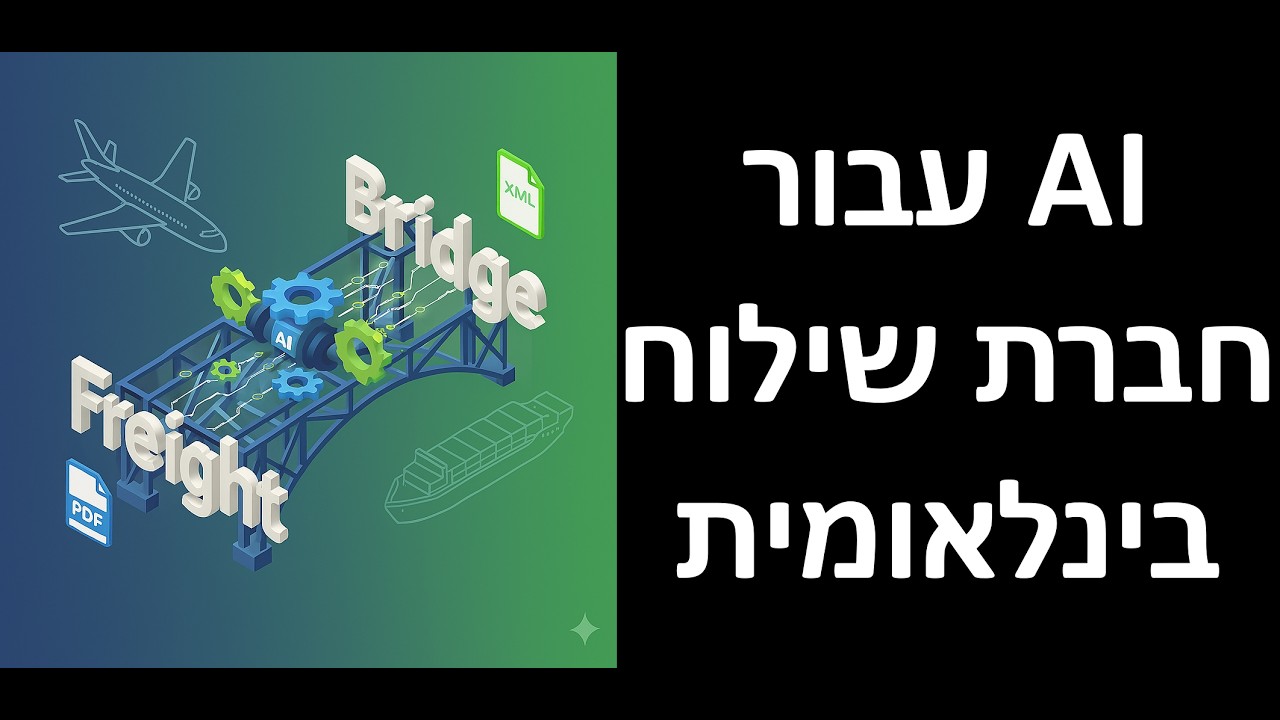
Ask a shipping agent where their day actually goes. Not on negotiations, not on firefighting — on retyping. Every shipment lands wrapped in a fresh pile of documents: bills of lading, port manifests, container lists, weight sheets. Every sender formats them differently, yet every document hides the same small handful of facts: two ports, a vessel, a bill of lading number, some containers, some weights.
This video shows an AI tool built for exactly that mess: it reads the documents and enters the data straight into the agent’s software — so nobody has to retype anything.
The demo
Ariel walks through a real logistics workflow: an importer in Israel named Shuki orders “Blue Bamba” from a candy supplier in South Korea. The supplier hands the cargo to a shipping line. The shipping agent — Shiluhoni Ltd — sits in the middle and coordinates everyone: supplier, shipping lines, ports, and the importer.
Documents pour in from all of them, and none share a fixed structure. What the agent does know in advance is exactly which data points to pull from every document: port of departure, port of destination, vessel name, bill of lading number, container count, container types, weights, and so on.
It gets messier. The supplier might only fill a third of a container — in which case several importers share one container and several participants ride on the same shipment. This is real-world paperwork, not a tidy lab dataset.
What the AI does
- Reads unstructured documents — bills of lading for sea or air freight, regardless of layout.
- Extracts the pre-known data points — ports, vessel, container details, weights, quantities, participants.
- Hands the data to the target software — in this demo, a freight management system called Unifreight. The handoff itself is an XML file that Unifreight knows to pull in on its own.
- Skips the manual copy-paste — no human ever retypes port names or container numbers.
The integration is deliberately unglamorous: the AI leaves a file where the target system knows to look. Is that an API? Ariel says yes, and he is right — an API is any programmatic handoff of information between systems. It does not have to be a shiny JSON REST endpoint; XML, CSV or SQL, it is all the same idea.
The closing pitch is blunt. The demo ends on a real client’s system — reports and graphs included — and the tool, they say, saves the cost of an entire employee: a full monthly and annual salary.
🔥 Roast Corner
You know what most “AI for logistics” tools actually are? A PDF parser with a ChatGPT wrapper and a pricing page that says “Enterprise” in a bigger font.
The real value was never “AI reads a document.” The real value is AI reads the document and puts the right numbers in the right fields of the software the company already uses. Everyone can extract text. Almost nobody finishes the job — that second half is exactly where 90% of AI demos fall apart.
Shipping paperwork is also nastier than it looks. Documents that look structured to a human eye are chaos to a naive parser. A bill of lading is not an invoice. A master bill and a house bill are not the same thing — the paperwork actually arrives as a bundle: one master bill for the shipment, plus separate house bills for each participant. And one shipment can carry multiple participants sharing a single container. If your AI does not understand all of that, you are not solving the problem — you are selling a parlor trick.
This demo, at least, shows the full loop: document in, data out, target software updated. That is the bar.
🤖 AI for Humans
If you do not work in logistics, here is the pain in one image:
Imagine 50 different emails landing in your inbox, each with an attachment that looks slightly different, and your job is to pull the same five facts out of every attachment and type them into a spreadsheet. Now imagine doing that hundreds of times a week.
That is the daily life of a shipping agent.
AI can help:
- Reading the attachments — even when the formatting changes from one sender to the next.
- Finding the facts the agent needs — ports, container numbers, weights, quantities.
- Typing those facts into the company’s software — so the agent does not have to touch the keyboard.
It is not magic, and it is not replacing the agent. It removes the boring, repetitive part of the job so the human can focus on the parts that actually need a human: exceptions, relationships, decisions — and the occasional shipment that goes sideways.
Published 2026-10-06 from the YouTube demo by Ariel Rubinstein.
💬 Comments