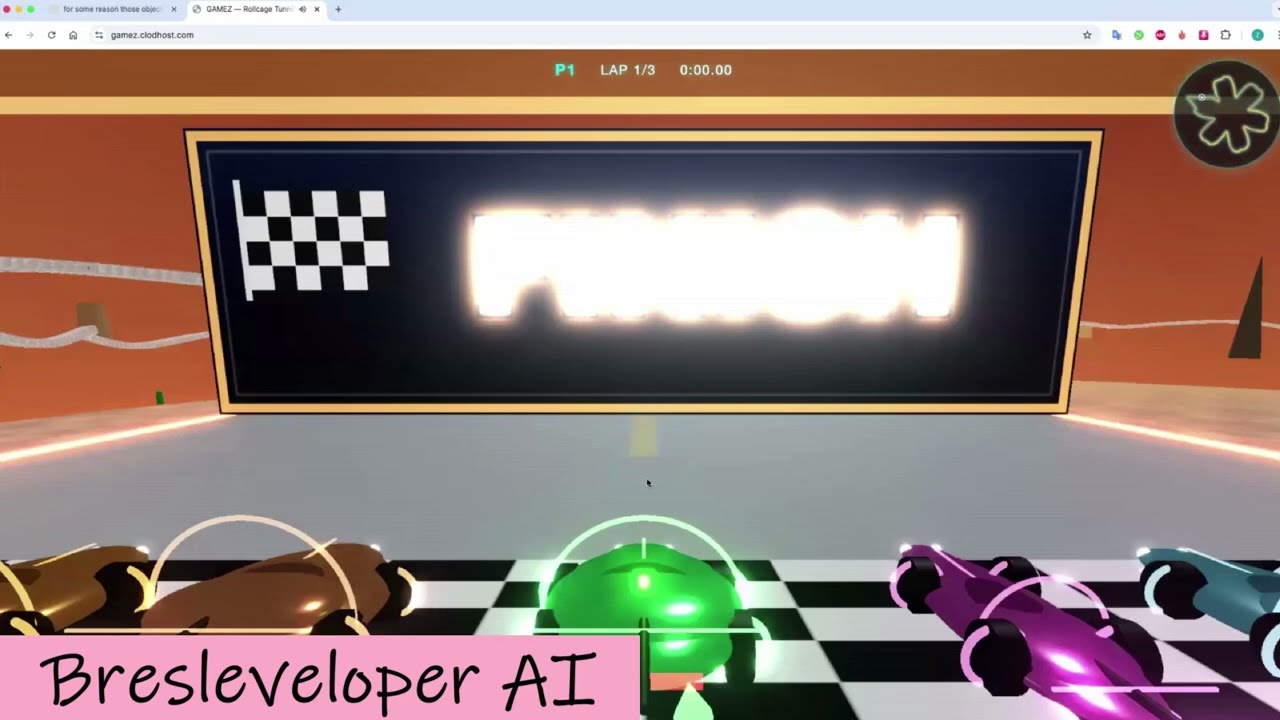
Another student from the community comes on stream, shares his screen, and casually drops a working race game. He does not know how to code. He did not pay for hosting. He just kept talking to an AI and shipping.
The game is rough, loud, and unmistakably AI-generated in places. It is also real. You can drive, collide, get pushed, use shields, and watch yourself climb a leaderboard. That puts it ahead of 90% of “learning to code” projects that never leave the tutorial.
What he actually built
The student is using clodhost, a free platform that gives him one server and one host. He connected it to Claude Opus and has not been asked to pay once. No token cap, no hard stop, no billing anxiety — just a working environment where the AI writes the code and he steers the result.
The current project is a racing game on a flower-shaped track. Multiple cars, engine sounds, a mini-map, and a leaderboard in the top-right corner. He is sitting in fourth place out of eight and clearly proud of it.
Key mechanics he demoed:
- Boundaries. The track has hard edges so cars cannot fall off. Smart — falling off every two seconds is not fun.
- Collision physics. When two cars crash, they stop. If you have a shield, you can push another car without taking damage yourself.
- Doubled track length. The first version was too short, so he asked the AI to make it longer. Now it is long. Maybe too long.
The moment Ariel starts coaching
Ariel does not just applaud. He points out the real problem: the track is now long, but there is nothing to do along the way. Longer is not automatically better. A stretched empty road is still an empty road.
His suggestions are direct:
- Add more players, challenges, or events between checkpoints.
- Give the player something to react to besides the finish line.
- Keep the sound effects — the lawnmower engine is ridiculous and great.
That is the difference between a coding exercise and a game: a game needs tension, choice, and pacing. The student is learning that by feel, because he is actually playing his own work.
From the first game to the second
This is the student’s second game. The first one taught him the basics; this one already has better structure, a real map, and working multiplayer logic. The graphics still look like a green salad exploded in a blender, but the experience is improving.
Ariel’s main point: the graphics do not matter right now. What matters is that the student is iterating in public, accepting feedback, and turning vague ideas into playable loops. That is the muscle that separates people who talk about AI from people who ship with it.
🔥 Roast Corner
Let us be blunt. The game looks like it was built by a very enthusiastic lawnmower that discovered Unity. The track is green, the cars are basic, and the engine sound belongs in a 1998 Flash game. If you showed this to a professional game studio, they would ask if the art direction was “Microsoft Paint on a deadline.”
But here is the twist: it runs. It has a server. It has collisions. It has a leaderboard. Most “real” developers have half-finished side projects that never reached that bar.
The real roast is for people who still think AI-assisted coding is cheating. This student shipped two games while those people were still arguing about whether prompt engineering is “real” engineering.
🤖 AI for Humans
This is what AI-for-humans actually looks like: a person with an idea, a free server, and a model that turns sentences into code. He is not replacing programmers. He is becoming one by accident.
The clodhost setup matters. It removes the classic friction of “where do I even host this thing?” If a student can spin up a server, connect Claude Opus, and publish a game without a credit card, the barrier to entry collapses. That is how new builders are made.
For humans watching this, the lesson is not “AI will make your game for you.” The lesson is AI lowers the cost of trying. You still need taste, you still need feedback, and you still need to know that a long empty track is boring. But you no longer need five years of coding school before you can find that out.
The student is proving it in real time: second game, visible improvement, and still no idea how to write raw code. That is not a bug. That is the feature.
Published 2026-08-27 from the YouTube video by Ariel Rubinstein.
💬 Comments