Model cards love two numbers: how many parameters a model has, and how many are “active.” Most people read the first one and ignore the second. In this short explainer Ariel shows why the second number is the one that decides how fast a model answers and how good the answer is, and what the big number is actually good for. Then he gives his personal verdict on the Chinese open models he uses.
What “Mixture of Experts” means
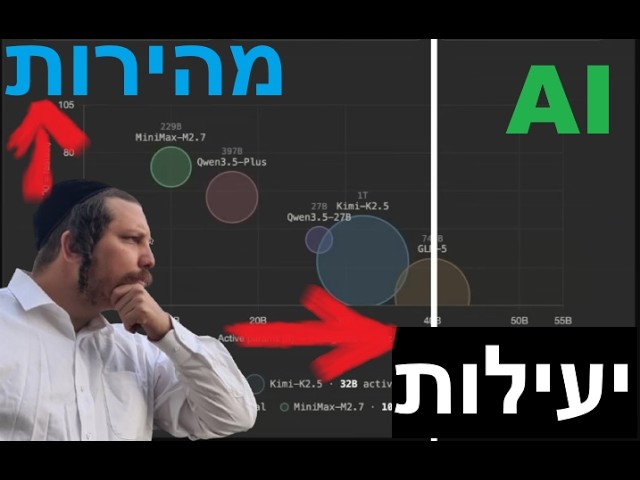
Ariel starts with a speed comparison chart (borrowed from another YouTuber’s model comparison, credited in the video). At the top sits MiniMax: 230 billion parameters, but only 10 billion of them active.
That’s Mixture of Experts (MoE). The model is huge, but a question doesn’t go through all of it. It gets routed along a few paths, and only the strongest, most relevant parts “light up,” in this example a maximum of about 10 billion parameters. Ariel compares it to the human brain: when a certain area is stronger on a subject, that’s the area that works on it. The rest of the model stays switched off for that answer. You ask a 230-billion-parameter model, and the answer is produced by about 10 billion of them. That’s why it’s so fast.
Active parameters: speed on one side, quality on the other
Then he walks down the chart, and the pattern is consistent:
- MiniMax, 230B total, 10B active: very, very fast.
- Qwen 3.5, about 400B total, 17B active: slower, but the quality of the output goes up.
- Qwen 3.5 27B, a much smaller 27-billion-parameter version: slower again, quality up again.
- Kimi 2.5 and 2.6, around a trillion parameters with 32B active: the speed keeps dropping, the quality keeps rising.
- GLM-5, about 40B active: same story.
The simple rule: if you need a model that answers fast, for whatever reason, pick one with few active parameters. If you need strong, high-quality answers, a good planner, a good thinker, you need more active parameters.
So what does the total size buy you?
If only a slice of the model works on each answer, why care whether it’s a trillion or 400 billion parameters? Ariel’s answer: breadth of knowledge. With Kimi, the biggest of the bunch, you can ask about things GLM knows a bit less about, and Qwen and MiniMax know even less. There will be questions the smaller ones simply can’t answer. That’s also part of why Kimi is considered the most creative model of the group.
Kimi vs GLM is like Claude vs GPT
Compared to Western models, Ariel says Kimi is usually the one called “the Claude replacement”: a bit more creative, a bit more thoughtful. GLM is more like GPT. It handles clear tasks over a longer range and breaks code down well. When you have a super clear, well-defined process, like reverse engineering some code, that’s where GLM shines. Ariel also credits it with a much larger context window than the others (he says a million tokens; the GLM-5 model card lists roughly 200K, so check the card for the version you use).
When you don’t quite know what you want yet and need to think and explore, that’s Kimi. Since Kimi 2, and certainly 2.5 and 2.6, it also codes very well.
Ariel’s personal take
- His go-to Chinese model is Kimi 2.6. He hasn’t tried Kimi 3 yet; he’s waiting for it to reach the open-licensed world.
- Qwen 3.5 is good when you tell it exactly what to do, but at that point he starts asking what he gained by going to a smaller model. It even feels a bit weaker to him than MiniMax.
- MiniMax 2 was very good in all aspects and handled OpenClaw very well. MiniMax 2.7 disappointed him a lot; it just didn’t work for him. (The auto-transcript garbles the model names a little in this part, so these are our best reading of it.)
- He’s clear that these are personal experiences, and that he doesn’t run local models: no graphics card at home.
The video ends with an invitation to his community: courses on starting with AI, setting up a work environment, launching projects, security, and a course in progress on building agents in Copilot for people in organizations, plus a weekly Zoom with him.
🔥 Roast Corner
Let’s start with the industry, because it earned it. Mixture of Experts means a model with 230 billion parameters where only 10 billion show up to work on any given question. Kimi has a trillion parameters and 32 billion active: that’s about 3% attendance. Somewhere, a government office is reading this and feeling seen. And then they name the things. The actual official name of the Qwen model in this video is Qwen3.5-397B-A17B. That isn’t a model name, that’s the Wi-Fi password at a hotel in Hangzhou.
Now Ariel. A man with no graphics card at home just gave a detailed lecture on the internal anatomy of models he has never run on his own machine. His review style is “2.7 disappointed me very, very much,” which is exactly how a father talks at a parent-teacher meeting about the middle child.
And the million-token context he gave GLM? The GLM-5 model card says about 200K. Turns out Ariel’s numbers are Mixture of Experts too: only about 20% of them are active.
🤖 AI for Humans
Weather forecasts beyond two weeks have long been close to useless. Forecasters call the two-to-six-week range the “predictability desert,” and one MIT scientist compares forecasting it to rolling dice at a casino. That’s a real problem: in 2021, winter storms in Texas caused the worst energy infrastructure failure in the state’s history, and at least 246 people died. More warning could have meant more fuel brought in, and less damage.
A team including MIT research scientist Judah Cohen, Harvard and University of Toronto researchers, scientists at the European Centre for Medium-Range Weather Forecasts, and researchers at Microsoft has built a machine-learning layer that learns from an existing forecasting system’s past mistakes and corrects its output. Applied on top of a gold-standard model, it doubled forecasting accuracy in the two-to-six-week range, won first place in an ECMWF forecasting competition, and, for the first time, beat the long-term climate averages for that range. It also improved predictions of extreme events like floods and cold spells. That gives farmers, energy operators and emergency teams more time to prepare. The work was published in Nature in October 2026.
There’s a nice echo of this video here: the model was trained on a supercomputer, but it doesn’t need a supercomputer to run. Like Mixture of Experts, the smart part is knowing where to spend the compute.
Source: MIT News, “Researchers improve weather forecasts looking two to six weeks out”
💬 Comments