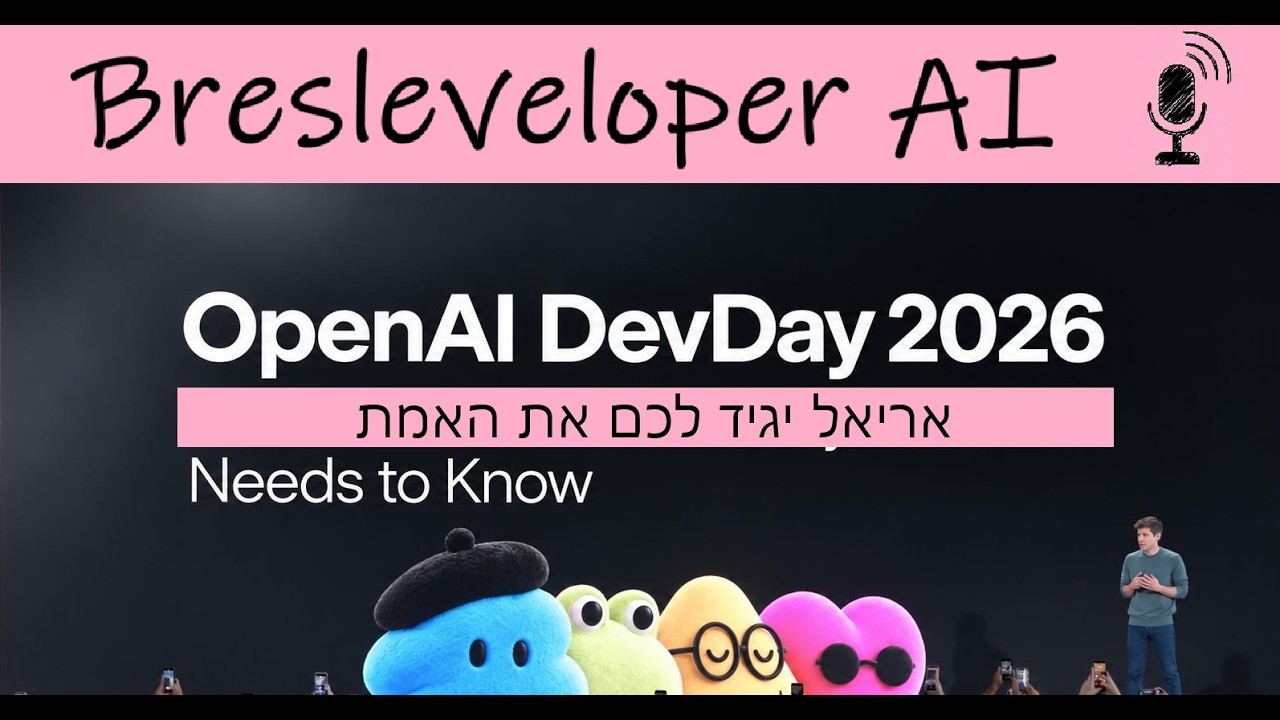
OpenAI held DevDay 2026 on September 29 and dropped more than twenty announcements in one keynote. Ariel’s October news video goes through the list and sorts it into three piles: what’s worth your attention, what’s noise, and the one change that will quietly reshape how everyone pays for AI. Fair warning, he says it upfront: he hasn’t tried everything himself. This is what he read, watched and saw other creators do with it, filtered through someone who has never been an OpenAI fan.
Dots: OpenAI’s always-on agent
The headline product is dots: persistent agents that live in the cloud, connect to your apps, and get a whole computer of their own.
Ariel puts it in context. First came OpenClaw, the personal AI that lives on your WhatsApp, Discord, Telegram, website or computer and can do pretty much anything. Then came the real competitors, like Hermes, and the “half-strength” ones: desktop apps like Claude Desktop and the Codex app, which are nice and polished but aren’t an active personal assistant. You open them, they work, you close them. Then Grok’s bot arrived, with the catch that it only runs on a Grok subscription and only in their cloud, but every agent gets a full computer.
Dots look closest to that Grok model. His verdict: he’s staying with OpenClaw. He didn’t move to Hermes, to dots or to Grok’s bot, and doesn’t see a reason to. Buy three small, cheap laptops, put OpenClaw on each, and you have agents with their own machines. Got a GPU? Run local models. No GPU? Connect them to your Claude. No extra subscription required.
Pages: shared documents for people and agents
OpenAI also launched ChatGPT Space and Pages: documents that several people (and agents) edit together, in the style of Google Docs or Microsoft 365. Useful, not revolutionary, and again something Ariel has only seen demoed.
The models: Astra, Sol, and politics
Some timeline first. GPT-6 Astra, OpenAI’s flagship, came out at the start of September. Anthropic’s Claude Opus 5.5 landed about a week before DevDay. And at DevDay OpenAI released GPT-6.1 Sol, which it says nearly matches Astra on coding and computer use at one-fifth of the token price. (OpenAI’s naming: Luna is the moon, Sol is the sun, Astra is the stars.)
Ariel’s read:
- Astra is impressive. People are excited about it with good reason. What creators are building with it in 3D is wild.
- Opus 5.5 is close behind in general intelligence, and in his view a bit ahead when it comes to programming.
- Sol hasn’t proven itself. In the demos he’s seen, it doesn’t hold up next to Astra, and certainly not next to Claude’s 5.5 series. His guess is that it’s a price play, because Anthropic also brought strong models down in price, and OpenAI had to answer with something.
His general position hasn’t changed: if he’s going for a top-tier model, he goes to Claude. If he’s giving up on top tier, he goes to the Chinese models. GPT always feels stuck in the middle to him: clearly smarter than the Chinese models, hats off, but not the one he reaches for.
Ultrafast mode
Ultrafast is a speed tier. OpenAI reports up to 8x faster token generation in Codex. In ChatGPT it’s only on the new top plan. Ariel doesn’t know whether it’s a faster model or just more servers up front, but people who have used it say it’s very, very fast. If you need very high intelligence and speed, this is where OpenAI delivered.
The Decisions API: a guardrail model
This one is easy to miss and Ariel likes it. The Decisions API (in limited preview) uses OpenAI’s Luna model to choose from a fixed set of answers you define. You don’t get text back. You get a decision: yes or no, or “this is 85% dog, 10% giraffe, 5% cat.”
Why that matters: a lot of people put AI into automations, and the AI improvises. Ask it to route a support ticket to the right department and it might invent a department that doesn’t exist, or return the right one with a typo. A decision model gets the list of departments and picks one. It’s fast, precise, and leaves no room for creativity, which is exactly what you want as a guardrail on the final step of an AI pipeline. If you’re not on OpenAI, there are open-source models that do the same job.
Codex keeps pushing into code
Both Codex and Claude keep pushing harder into coding. OpenAI added Codex Security Cloud, which scans repositories for vulnerabilities and prepares fixes. Ariel admits he doesn’t know yet how deep it goes.
The plans: a price hike in disguise
Here’s where the money changes. According to Ariel’s breakdown, the old $100 and $200 plans gave you 10x and 20x the base usage. Now the $100 plan gets 5x, the $200 plan gets 10x, and a new $500 plan gets 25x plus Ultrafast. In other words: the same money buys about half of what it used to.
Sign in with ChatGPT: the real headline
This is the feature Ariel thinks matters most. Sign in with ChatGPT works like “Sign in with Google,” except you bring your AI. Apps that need you to supply your own model let you log in with your ChatGPT account, and you can use your ChatGPT plan’s allowance inside them. OpenAI launched it with 16 partner products.
ChatGPT always left this door open: your subscription, use it however you want. Claude, Grok and Gemini blocked third-party use of subscriptions, and on Claude’s side that only changed a few days before the video. Claude now has its own route for using your subscription in third-party products, but the pricing is different: you get noticeably less usage when you work through an outside tool. (Ariel promises a separate video on this.) He thinks Claude moved because of Sign in with ChatGPT, which is great news for anyone who wants to run OpenClaw on Claude again.
His theory about the price hike connects the two. A human uses a subscription like a human: works while awake, stops to eat, stops to sleep. An agent running on your subscription works 24/7. Once you let everyone take the subscription outside, usage explodes, so OpenAI doubled the prices. Claude went the other way: keep the prices, but charge more when you take the subscription outside.
The bigger trend is bring your own tokens. Some providers serving Chinese models have supported it for a while. Now that OpenAI opened it, and Claude followed, expect to see “bring your own tokens” everywhere, including from service providers who’ll let you plug in your own account.
The verdict
- Models: no real step forward.
- Products: no real step forward either, in his view.
- Plans: prices effectively doubled, but you can now take the engine anywhere you want, and Ariel thinks that’s worth the hike.
🔥 Roast Corner
Let’s start with the reviewer. Ariel’s DevDay coverage is built on a bold journalistic method: “I haven’t tried it, I watched some YouTubers.” That’s not a product review, that’s a restaurant critic who rates the food by smelling other people’s plates through a window. Five stars for honesty, zero for field work.
Then his rebuttal to dots. OpenAI ships an always-on agent with its own cloud computer, and the answer from Bresleveloper HQ is: buy three cute little laptops and put OpenClaw on each one. Sir, that’s not a competitor, that’s a server rack with a family.
But OpenAI earned the bigger pinch. They announced more than twenty things in one keynote, and the day before the event they said they would not release GPT-6.1 Astra because it didn’t meet their safety standards, which Sam Altman then called the “normal course category.” They launched Ultrafast at six times the API price, cut what your $200 buys roughly in half, and called it choice. And the cherry on top: you can now use your ChatGPT allowance in 16 different apps. Congratulations, you can now run out of half the tokens in sixteen places at once.
🤖 AI for Humans
Most breast cancer screening asks one question: do you have cancer right now? Clairity Breast asks a better one: what’s your risk over the next five years? It’s the first FDA-authorized AI platform that reads a routine screening mammogram and estimates a woman’s five-year breast cancer risk. Radiologist Dr. Connie Lehman, who has been working on it since 2016, built it as CEO of the women’s health startup Clairity, training it on hundreds of thousands of mammograms from women of many ages and backgrounds.
Why it matters: according to figures cited in the article, about 85% of women who get breast cancer have no family history of it, so the usual risk checklists miss many of them. Clairity doesn’t diagnose. It flags women who should be screened earlier and more often, for example with yearly MRI, even when age or family history wouldn’t put them in a high-risk group. Until recently it was only available at a few medical centers. As of October 1, a partnership with the at-home testing company Everlywell makes it available to women across the US who’ve had a screening mammogram.
It’s the same idea as the Decisions API above, pointed at something that matters far more than ticket routing: give the AI one narrow question, and let it answer that question really, really well.
💬 Comments