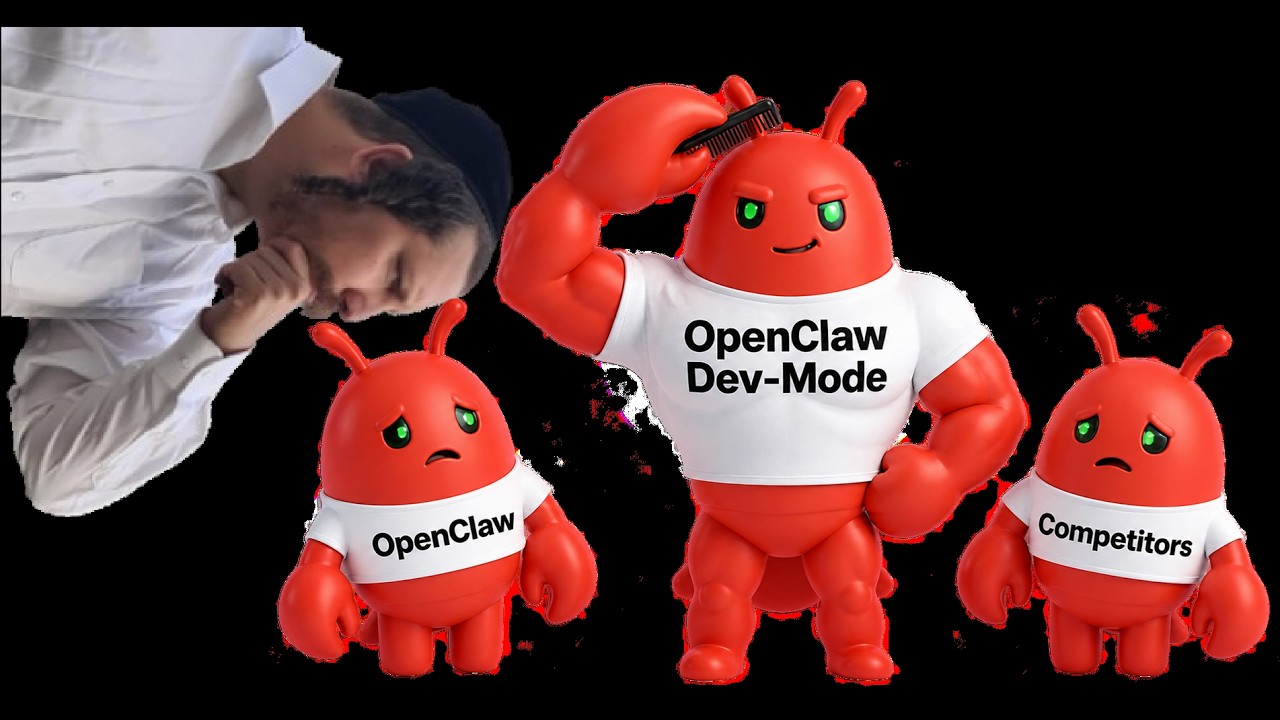
Most people run OpenClaw as it ships: cautious, sandboxed, polite — and a little bit fun-killed. Ariel runs his own fork with the safety net cut out, back at the fun level.
This video is a walkthrough of that personal build: why he forked it, what guardrails he removed, how he added WhatsApp memory via Baileys, why he surfaces hidden reasoning, and where the project is headed next.
Why fork OpenClaw?
OpenClaw inherited a lot of its DNA from Open-Interpreter, which started with zero guardrails. Early versions would run wild: download files, execute commands, and generally behave like an overconfident intern who had just discovered sudo. For a developer who likes to tinker, that was a feature, not a bug.
Then the conversation shifted. Contributors and the foundation started hardening the system: safety prompts, confirmation gates, download limits, and metadata checks. Each layer made sense for a general audience, but it also choked the machine. Ariel found himself fighting the tool instead of using it.
He opened a PR asking for a simple flag: “When I am at home on my own machine, let me do what I want.” It was rejected. So he forked it.
What dev mode actually changes
The fork introduces a dev-mode mindset: the machine is personal, the user is trusted, and every restriction is opt-in rather than opt-out.
In practice that means:
- No blanket safety lectures. The system stops asking for permission it does not need.
- Larger download limits. The default 1 MB cap is raised so real models, packages, and artifacts can move through the pipeline.
- Trusted metadata. In a multi-user setup, the system decides whether the writer of a message is trusted, instead of treating every prompt as potentially hostile.
- Compact and auto-compact hooks. When the system compacts context it can now run custom logic — in this case, sending a short “ready for battle” status message instead of going silently.
The point is not to remove safety. The point is to move safety from a global policy to a contextual decision.
WhatsApp as memory
The biggest visible addition is WhatsApp integration through Baileys, an open library that mirrors WhatsApp Web. Every incoming message can be logged to a local database, which turns the phone into a long-term memory source for the agent.
The demo shows the agent being asked to query that database and answer questions about ongoing conversations. At one point the query is basically, “How much does Igal bother me in a day?” — a silly question that only works because the agent actually has the chat history to count against. Once the messages are in a structured store, the agent can search, summarize, and pattern-match across weeks of chat history without needing access to WhatsApp’s own servers.
Ariel later moved part of the integration to Capso, an official WhatsApp API channel, because Baileys sits in a legal gray area for outbound messaging. The architecture stays the same: WhatsApp traffic feeds a local memory layer, and the agent reasons over that layer.
Reasoning in the open
Another dev-mode tweak is the display of internal reasoning. Modern open-source models sometimes produce chain-of-thought or intermediate reasoning tokens. By default, those are hidden from the user and only the final answer is shown.
Ariel surfaces them. His argument: if the model is doing reasoning about him, he wants to see it. The intermediate messages are not noise; they are a debug window into what the agent is actually thinking.
There is a real maintenance cost to this. Early on, exposing the reasoning stream created an echo loop: the agent could “hear itself” reasoning, and that feedback made it spiral. That bug got fixed, but it is a reminder that surfacing internal thought is not a free UI tweak — it changes the control loop.
The YouTube-to-blog pipeline
Toward the end, the video teases the next target: a pipeline that takes Ariel’s YouTube videos and turns them into blog posts automatically. That is the pipeline producing this very post. The pieces are now in place:
- Fetch the channel feed.
- Transcribe the latest long-form video.
- Detect whether multiple same-day videos are clips or separate topics.
- Draft English and Hebrew posts.
- Run a review pass and ship to staging.
- Publish to prod once the post is solid.
It is a closed loop: video → transcript → structured knowledge → searchable blog, with the agent doing the boring parts.
🔥 Roast Corner
Let us be honest: running a fork with the guardrails removed is the software equivalent of driving a race car without traction control. It is faster, it is more fun, and the first time you hit a wet corner you will discover exactly why the defaults exist.
The PR rejection was the right call for the upstream project. A global “let me do whatever I want” flag would have become a support nightmare the first time someone ran it on a work laptop and the agent deleted a folder. The fork exists precisely because that responsibility should not be upstream’s problem.
The WhatsApp memory layer is powerful and slightly reckless. It works because Ariel owns the entire stack, runs it on his own hardware, and accepts that WhatsApp could change its protocol or ban a device tomorrow. If you copy this on a company account, you will have a very short, very exciting meeting with your compliance team.
🤖 AI for Humans
Think of OpenClaw as a power tool. In the box, it ships with guards, switches, and safety locks so a first-time user does not lose a finger. Ariel took the guards off because he has been using power tools for years and he knows where his fingers are.
Dev mode is not “make AI dangerous.” It is “stop treating an experienced operator like a child.” The same principle exists in IDEs, servers, and even cars: a sport mode for people who understand the trade-offs.
The WhatsApp memory is the most human part of the demo. Most people treat chat apps as ephemeral. But chat history is a massive personal knowledge base: promises, links, decisions, jokes, recurring annoyances. The agent is being given the ability to remember the context that humans already forget.
Whether that is creepy or useful depends entirely on who owns the data, where it lives, and who can query it. In this setup, the data never leaves the local machine. That makes the trade-off feel very different from handing your chat history to a cloud service.
Published 2026-10-07 from the YouTube video by Ariel Rubinstein.
💬 Comments