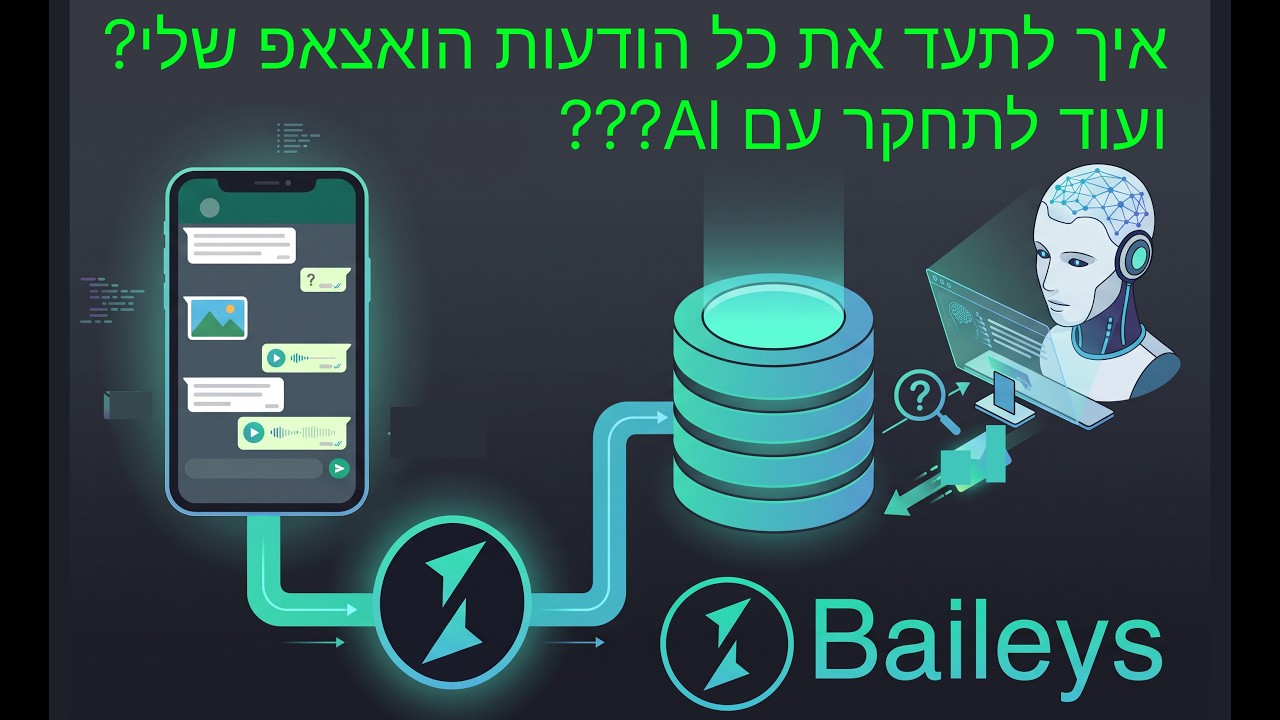
Your WhatsApp history isn’t really yours. It sits on Meta’s servers or inside an encrypted phone backup you can’t actually open, and the only search tool you get is the scroll bar. This video shows a different option: mirror your own WhatsApp traffic into a private database you control — then query it with AI.
What the demo shows
Ariel runs a small service that listens to his WhatsApp account in real time. Every message — incoming or outgoing — appears on screen the moment it happens: sender direction (“inbound” or “from me”), timestamps, and media flags. Even images come through. The idea is simple: anything that touches WhatsApp also gets written to his own database.
The mechanism: Baileys
The tool is Baileys, an open-source Node.js library that pretends to be another WhatsApp Web session. Instead of going through the official WhatsApp Business API, it connects the same way your browser does when you open web.whatsapp.com:
- Run the Baileys client as a background service. It’s an ordinary process — the computer just needs to stay on.
- It presents a QR code.
- Scan it from your phone under Linked Devices.
- From that moment on, Baileys receives exactly the same message stream WhatsApp Web would.
By default it has no user interface at all. It’s pure backend: attach whichever frontend you want, or pipe the events straight into a database.
Why this matters
Once your messages live in a database you own, you can:
- Search your full history with SQL or full-text search, instead of scrolling endlessly in the app.
- Run AI queries over your own conversations — summaries, pattern detection, “what did I promise last week?”
- Keep a backup independent of WhatsApp’s cloud storage and phone-local backups.
- Build automations that react to incoming messages without handing a third party access to your account.
This is the same architectural move we keep seeing across AI tooling: take data locked inside someone else’s app, copy it into a system you control, and layer intelligence on top.
The risk
Ariel is explicit about this: Baileys is not authorized by WhatsApp. It was built by reverse-engineering the WhatsApp Web protocol, and WhatsApp can detect abuse and ban accounts.
The safer pattern that emerges from the demo:
- Use it only to receive and log messages.
- Avoid sending automated messages through it, especially at scale.
- Older accounts seem to tolerate light personal use better than new ones used aggressively.
Ariel mentions two clients who used it for outbound messaging. Both had their accounts closed; only one got theirs reopened. That’s the risk profile in one sentence.
How it fits into larger stacks
The same Baileys module ships as a channel plugin in platforms like OpenCloud and Armis. Enable it, scan the QR code, and your CRM, agent system, or database can talk to WhatsApp the same way it talks to Telegram, email, or SMS. The difference here is the goal: personal data ownership rather than customer broadcasting.
🔥 Roast Corner
Let’s be honest: this is not a polished, approved integration. Baileys is a hack — a clever, useful, open-source hack, but still a hack. It works because WhatsApp hasn’t fully closed the browser-session protocol, and it stays alive only as long as Meta tolerates it.
The people who get burned are the ones treating it like a free bulk-messaging API. WhatsApp’s anti-spam systems are not stupid: abuse a linked device and you lose the device — and possibly the account.
The real value was never “send WhatsApp for free.” The real value is owning your own conversation data. If that’s the goal, this approach makes sense. If the goal is cheap marketing automation, use the official channels — they cost money precisely because they don’t get your account banned.
🤖 AI for Humans
Imagine every email you ever sent lived only inside Gmail’s app, and the only way to find an old message was to scroll. That’s roughly how WhatsApp works for most people.
What Ariel does here is the IMAP move: the equivalent of downloading your Gmail into your own mail client, pulling the messages out of the walled garden and into a place where you can search, filter, and analyze them.
The AI part comes after the backup. Once the messages sit in a database, you can ask things like:
- “Summarize last week’s conversations with my clients.”
- “What did I agree to do in the family group this month?”
- “Find the link someone sent me last week.”
The hard part is not the AI. The hard part is extracting your data cleanly — without burning your account. Baileys solves the technical half; the risk management half is on you.
Published 2026-09-17 from the YouTube video by Ariel Rubinstein.
💬 Comments