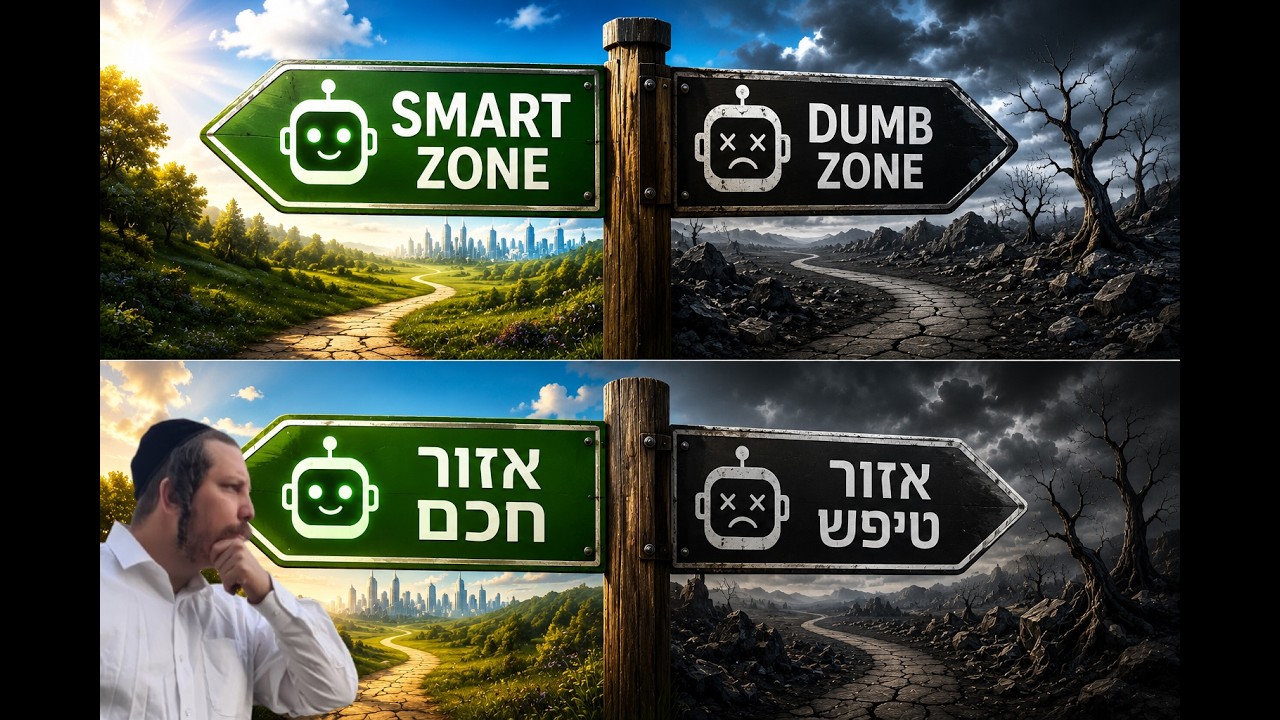
Most people treat a language model like a magic box: words go in, words come out, and sometimes the answer is brilliant and sometimes it is nonsense. This video pulls the lid off the box and explains one of the most practical ideas in modern AI: the smart zone and the dumb zone.
Ariel walks through how a neural network actually processes input, why attention is a finite resource, and why every long conversation eventually hits a wall where the model starts forgetting what you asked at the beginning.
How an LLM actually works, in five minutes
Under the hood, a large language model is a stack of layers. Each layer is made of neurons, and every neuron is connected to neurons in the next layer. When you type a word, that word is converted into a number — a token — and that number flows through the network.
Each neuron runs a small math function called an activation function. It decides whether to pass the signal forward or stop it. In practice, this means the model is constantly turning some pathways on and others off. The “mixture of experts” architecture takes this idea to an extreme: instead of activating all two trillion parameters at once, it only fires the strongest 100 million or so. The rest stay dark.
This is the 80/20 rule at machine scale. The neurons that matter most do most of the work, and ignoring the rest makes the model faster and cheaper without destroying quality.
Next-token prediction, repeated
The model does not write a full answer in one shot. It predicts one token at a time, then feeds that token back into the input and predicts the next one. “The cat is…” becomes “nice,” which becomes “kitty,” and so on.
So if you ask “what is the color of the cat,” the model does not answer in a single flash. It runs the whole pipeline once to produce “The color,” then again with “The color” added to produce “is,” then again to produce “blue.” Every word costs another full pass through the network.
Attention: the real bottleneck
Before the tokens hit the layers, the model runs an attention step. It reweights the input so that important words get more focus and filler words get less. In the question “what is the color of the cat,” the words “color” and “cat” get high weights; the rest get pushed down.
That reweighting is the secret behind the smart zone and the dumb zone. Attention is finite. The model has a maximum amount of focus it can distribute across the conversation. The more words you pile on, the thinner that focus gets. The first ~200,000 tokens are still crisp because the important words keep their weight. After that, the model enters the dumb zone: it starts mixing things up, forgetting earlier details, or answering a question you did not ask.
This is not a bug in the training. It is a physical limit of the attention budget.
How to stay in the smart zone
There are three practical ways to avoid the dumb zone:
- Start a new session. Brutal but effective. You lose the full conversation, but you get a fresh attention budget.
- Auto-compact. The model summarizes the conversation into a compressed document and starts a fresh session from that summary. You keep the gist, but you lose detail.
- Use subagents or hand-offs. Split the work across multiple focused sessions, each with its own tight context. This is why programmers love subagents: every agent gets a fresh smart zone for its specific task.
Many frontier models historically capped context at 256K tokens for exactly this reason. Why advertise a giant window if everything past 200K is fuzzy?
Memory that survives compression
Auto-compact is useful but lossy. Important decisions can get smoothed away. The better practice is to keep a decision file or decision log: a file where every key choice is written down explicitly.
For medium projects, a markdown file is enough. For larger projects, move to a database the agent can query. For massive, unstructured knowledge, use a semantic database with embeddings — this is the foundation of RAG. The model stores weighted representations of concepts, so when you ask about a “car” it can also surface information about “vehicles.”
For relationship-heavy data — who worked where, who reports to whom — a graph database is the right shape. It lets the model reason across connections the same way LinkedIn maps professional networks.
🔥 Roast Corner
The phrase “smart zone” sounds like marketing fluff, but it is actually a polite way of saying “this thing has a goldfish memory and you are feeding it too many flakes.”
People love to brag about 1M-token context windows, but a huge window does not mean the model pays attention to everything inside it. It means the model has more rope to lose the thread with. The smart zone is a practical fiction we use to pretend the model stays sharp. It does not. It just stays sharp enough for most tasks.
Auto-compact is the AI equivalent of asking someone to take notes during a meeting and then burning the recording. The notes are fine until you need the exact wording of a decision, at which point you discover the summary wrote “discussed cats” when you actually agreed the cat was blue.
🤖 AI for Humans
Think of attention like a flashlight in a dark room. The room can be huge, but the beam is only so wide. When the room is empty, you see everything you point at clearly. When the room is packed with furniture, the beam scatters and you start missing details.
A long chat with an LLM is the same. Early on, the beam is tight. Every word matters. Later, the beam is spread across hundreds of thousands of tokens, and the model starts guessing which shadow is the cat.
The fix is not to build a brighter flashlight — that is expensive and eventually impossible. The fix is to clean the room. Summarize, split tasks, write decisions down, and let different agents handle different corners. The smartest way to use AI is not to dump everything into one chat. It is to keep each chat small enough that the beam stays bright.
Published 2026-08-27 from the YouTube video by Ariel Rubinstein.
💬 Comments