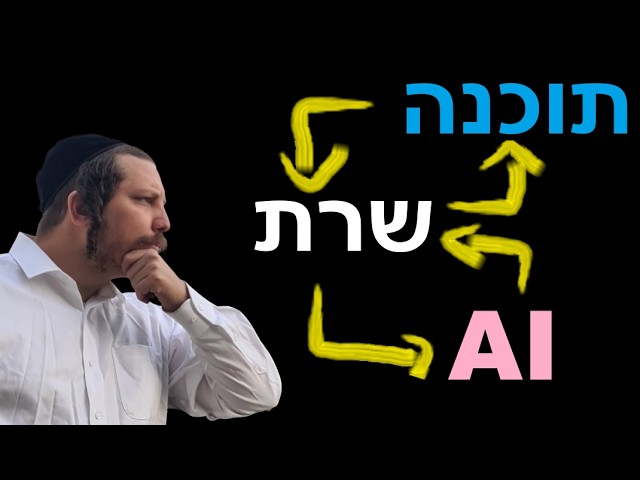
Someone asks “so where does N8N actually run?” and suddenly half the room realizes they never knew where any of their tools run. This short clip is Ariel’s whiteboard answer: three layers, one question about N8N, and a mental model that makes every automation tool easier to understand.
Layer 1: the software (what users touch)
This is the part people actually log into. It could be a CRM, an automation tool like N8N or Make, or a database like Airtable. The users (in the video: “Ariel” and “Sarah”) don’t care where it lives. They open it, click things, get results.
Layer 2: the server (where it runs)
The software has to run somewhere. That might be a beefy server in a data center, or it might just as easily be sitting on Ariel’s laptop. For the user it makes no difference. The only rule: it needs a machine to run on.
Layer 3: the AI function (who does the thinking)
Here’s the part beginners mix up. The software on that server can use an AI function to help it make decisions or produce answers. But the software isn’t “the AI”. To think, it has to connect to an AI provider: GPT, Claude, or a router like OpenRouter that gives you many models through one door.
So the flow is: user → software → (on some server) → AI provider → answer back to the software → answer back to the user.
The N8N vs Make answer
This is where the original question lands:
- Make lives only on Make’s own servers. Your scenario runs there, Make’s server calls out to an AI provider in the cloud, gets the answer, and passes it back to you. You don’t get to choose where it runs.
- N8N is open source, so it can sit on your server or even your computer. From there it can call a cloud AI provider (GPT, Claude, and so on) just like Make, or it can call a local AI running on the same computer or on a local server.
That second option is the whole point. If your data shouldn’t leave the building, or you just want to stop paying per token for simple tasks, N8N plus a local model keeps the whole chain (software, server and AI) under your roof.
The takeaway
Before you pick a tool, draw the three boxes: What software do my users touch? Where does it run? Which AI does it call, and where does that AI live? Once you can answer those three, “N8N or Make?” stops being a religious debate and becomes a simple question about who owns the server.
🔥 Roast Corner
Ariel drew three boxes and some arrows and explained the entire automation industry in under two minutes. Respect. But notice which box is missing from the whiteboard: the human who looks at the output. The industry noticed too, eventually. In October 2026, Just Eat apologised after its AI started generating menu photos for restaurants that didn’t have pictures yet. “Bacon and egg soda” (a Belfast soda bread dish) became a glass of fizzy cola with a fried egg and bacon floating in it. A “chip muffin” became chips stabbed into a muffin. A “cheese roll” became cheese sushi. Software layer: fine. Server layer: fine. AI provider: answered instantly and with total confidence. Human layer: on lunch break, presumably ordering something that wasn’t cola-flavoured bacon.
That’s the real lesson of the three-box diagram. Every box in it will happily do its job perfectly and still serve you breakfast in a soft drink. And Ariel, before you wire N8N to a local model and go to sleep, remember: your laptop is now “the server”. The day it decides to install updates in the middle of a client’s workflow, the box you forgot to draw will be you, at 3 AM, explaining to Sarah why the CRM is having a spa day.
🤖 AI for Humans
Same architecture, used for something that really matters. In Mumbai, the NGO Missing Link Trust, together with Capgemini India, launched Khuli Baat (“open conversation”): an AI-powered WhatsApp chatbot that helps parents, teachers and caregivers talk with children about child safety: boundaries, consent, online risks, abuse and exploitation. It also points people to support and reporting resources. Anyone can reach it by sending “Hi” on WhatsApp.
The software layer here is the one everyone already has on their phone, and the AI behind it draws on a curated knowledge base built from more than a decade of the organization’s field work, designed with attention to gender, bias and power dynamics. It supports the NGO’s prevention programmes in 100 municipal schools in Mumbai’s East Ward, where the plan is to bring safety education to about 10,000 adolescents, while the bot helps the adults around them recognise warning signs and know what to do.
Why it matters: citing India’s National Crime Records Bureau, the organization notes 69,191 cases registered under the country’s child-protection (POCSO) law in 2024, with people known to the child involved in more than 96% of them. The adults closest to a child are the first line of defence, and a judgment-free chat on WhatsApp is about the lowest barrier there is. As the Capgemini lead put it, the technology isn’t replacing human relationships; it’s equipping adults to protect children better.
💬 Comments