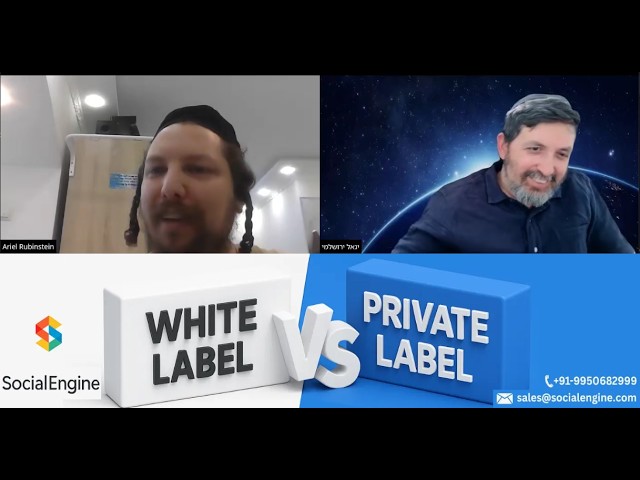
Ariel and Igal sit down to settle an argument that every product builder hits eventually: someone wants to sell your software under their own brand. Should you let them?
This podcast episode is a blunt, practical breakdown of white-label versus SaaS, using everything from Turkish refrigerators to Microsoft resellers as examples. The bottom line is not about branding — it is about who owns the customer, the code, and the future of the product.
What white-label actually means
Ariel opens with a simple analogy. Most brand-name appliances are not built by the company on the box. One factory in Turkey makes the same refrigerator for multiple labels, each slapping on a different sticker and price tag. The product is identical; only the branding changes.
Software works the same way. Small cloud providers often buy a white-label storage or backup platform, rent server space from an infrastructure vendor, and resell it as their own service. The customer sees a polished UI and a local brand. Behind the curtain, the actual platform is someone else’s code.
The model is everywhere. Cloud storage, SEO tools, CRMs, marketing automation — many “in-house” products are white-labeled kits someone else built.
The reseller fantasy
A potential partner approaches Igal with a classic offer: “Let me be your reseller. Rebrand it as mine and I will sell it.” Igal sees distribution. Ariel sees a trap.
Ariel’s argument is that white-label only makes sense for the vendor when the product has something the reseller cannot easily copy. If the underlying code is generic — and in the age of AI, generic code is copyable in months — the reseller is not a partner. They are a temporary middleman who will either squeeze your margin or replace you.
He lists the risks from the creator’s side:
- No real IP leverage. All you own is the code. If the reseller can reproduce the workflow, your contract is the only thing protecting you, and contracts are expensive to enforce across borders.
- Race to the bottom. A reseller adds sales and support value, but you are still just the engine. If they find a cheaper engine, you are swapped out.
- Feature blackmail. Every reseller wants custom tweaks. Support enough of them and you are running a consultancy, not a product company.
- Brand risk. One bad reseller poisons the product for everyone else, and you cannot easily disown them because the customer thinks the product is them.
The better model: SaaS with service
Ariel’s counter-proposal is a hybrid. Do not white-label the product. Instead, sell a real SaaS subscription and let the reseller wrap services around it.
In this model the customer pays the creator directly for the software. The reseller handles onboarding, support, training, or local custom work. The reseller keeps their markup, but the product, roadmap, and customer relationship stay with the builder.
Ariel calls this the winning formula, especially in an AI era when raw software is no longer a moat. The value is not the code. The value is the service, the expertise, and the trust that the builder keeps improving the product.
The mental shift
The most important line in the conversation is this: software is not worth zero, but programming hours are worth zero. In an AI-assisted world, the time it takes to build a clone drops fast. What cannot be cloned as quickly is a relationship, a support practice, deep domain knowledge, and a product that keeps evolving.
That is why Ariel pushes back on white-label. If the only thing stopping a reseller from leaving is a contract, you have already lost. If the only thing keeping a customer is a sticker with someone else’s logo, you have no product.
🔥 Roast Corner
White-label is the business equivalent of letting someone borrow your car and pretend it is theirs. It works great until they crash it, sell it, or figure out they can buy the same model cheaper across the street.
Ariel is right to be paranoid. The phrase “I want to be your reseller” often translates to “I want to rent your engineering team while I build my own audience.” If your product is simple enough to white-label, it is simple enough to clone. If it is hard enough to clone, you should not be giving away the brand.
The Turkish refrigerator industry has been running this scam for decades. Do not let your software become a sticker.
🤖 AI for Humans
AI has made the white-label temptation both easier and more dangerous.
On one hand, a non-technical reseller can now stand up a polished-looking product with very little engineering. On the other hand, an AI-coding competitor can replicate that same product in a fraction of the time it used to take. The barrier to looking like a product company has collapsed. The barrier to actually being one has not.
The takeaway is simple: if you are the creator, keep the product. Sell subscriptions. Let partners sell services around it. Your code is replaceable. Your relationship with the customer, your roadmap velocity, and your willingness to support the hard edge cases are not.
If you are the reseller, do not ask for a white label. Ask for a partnership where you can add real service value. That is the only arrangement where both sides still need each other in two years.
Published 2026-09-06 from the YouTube video by Ariel Rubinstein.
💬 Comments